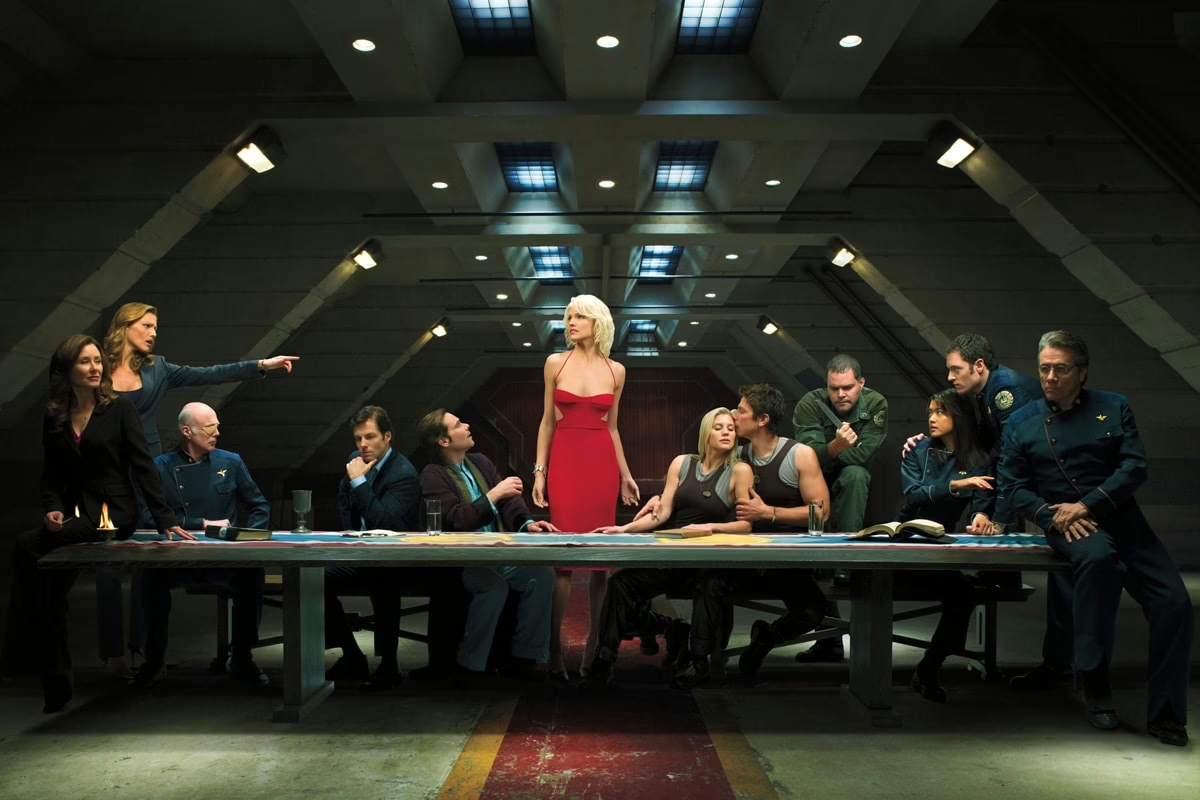
«Battlestar Galactica» is one of the most unusual examples of science fiction, where space is not just a setting for adventures, but a huge laboratory for studying human civilization.
On the surface, it is a story about the last remnants of humanity who, after the destruction of the twelve colonies, try to save themselves from the Cylons — artificial beings created by humans themselves. But if you remove the spaceships, battles, and technologies, what remains is a much older plot: a story of exile, search for home, clash of faith and reason, and trying to understand what makes us human in the first place.
«Galactica» is not so much a series about the future as a series about the past and present of humanity. It shows one of the oldest civilizational paradoxes: we constantly create new technologies, but remain hostages of ancient behavioral patterns.
The main philosophical idea of the series is expressed by the famous phrase:
«All of this has happened before. And all of this will happen again».
This is practically a formula of civilizational cyclism. The history of humanity in the series is not a straight line of progress where each generation becomes wiser than the previous one. Rather, it is an endless cycle:
This idea echoes the concepts of historical cycles of Oswald Spengler, Arnold Toynbee, as well as ancient notions of cyclical time in Hinduism and ancient philosophy.
The scariest conclusion of the series is not that machines can destroy humanity. The scariest conclusion is different: even after destruction, civilization might not change, because the problem lies not in technology, but in the very nature of intelligent beings.
The plot structure of «Galactica» is very close to the oldest religious myths of humanity.
People lose their home, become a nation of exiles, and embark on a long journey through the unknown in search of the promised land. This is practically a modern version of the biblical Exodus of Jews from Egypt.
The fleet of refugees becomes a kind of nomadic people:
From the point of view of evolution, this is an interesting idea: perhaps the next stage of intelligence development will not be the replacement of man by machine, but the emergence of hybrid forms.
The most relevant part of the series today is not space technology, but the question of the nature of consciousness.
Cylons demonstrate a problem that is becoming increasingly real in the era of artificial intelligence:
«Galactica» does not give a simple answer. It shows that intelligence can arise in an unexpected form, and along with intelligence come culture, religion, fear of death, and the search for meaning.
From the perspective of strict science, the series has a problem: it goes beyond physics and introduces elements of mysticism.
Prophecies, fate, intervention of higher powers, and the idea of cyclical repetition of history cannot be explained by the scientific method.
But that is precisely what makes the series interesting.
It is located on the boundary of several genres:
The finale of the series turns the whole story into a huge mythological loop.
The heroes find Earth, but it turns out not to be just salvation. They become part of the beginning of a new human history.
The civilization we call humanity turns out to be the result of mixing two branches of intelligent life — humans and Cylons.
A surprising paradox emerges:
we ourselves are descendants of those who once tried to destroy each other.
The war between man and machine was not the end of history, but a necessary stage in the birth of a new civilization.
The series asks one of the most difficult questions:
What makes us human?
Not origin.
Not body.
Not technology.
Humanity is determined by the ability to remember, create culture, love, make mistakes, and make choices.
«Battlestar Galactica» is not a story about space.
It is a story about humanity that created a mirror in the form of artificial intelligence and saw its own reflection in it.
And perhaps the main lesson of the series is that the future of humanity depends not on whether we create new forms of intelligence, but on what values and meanings we pass on to them.